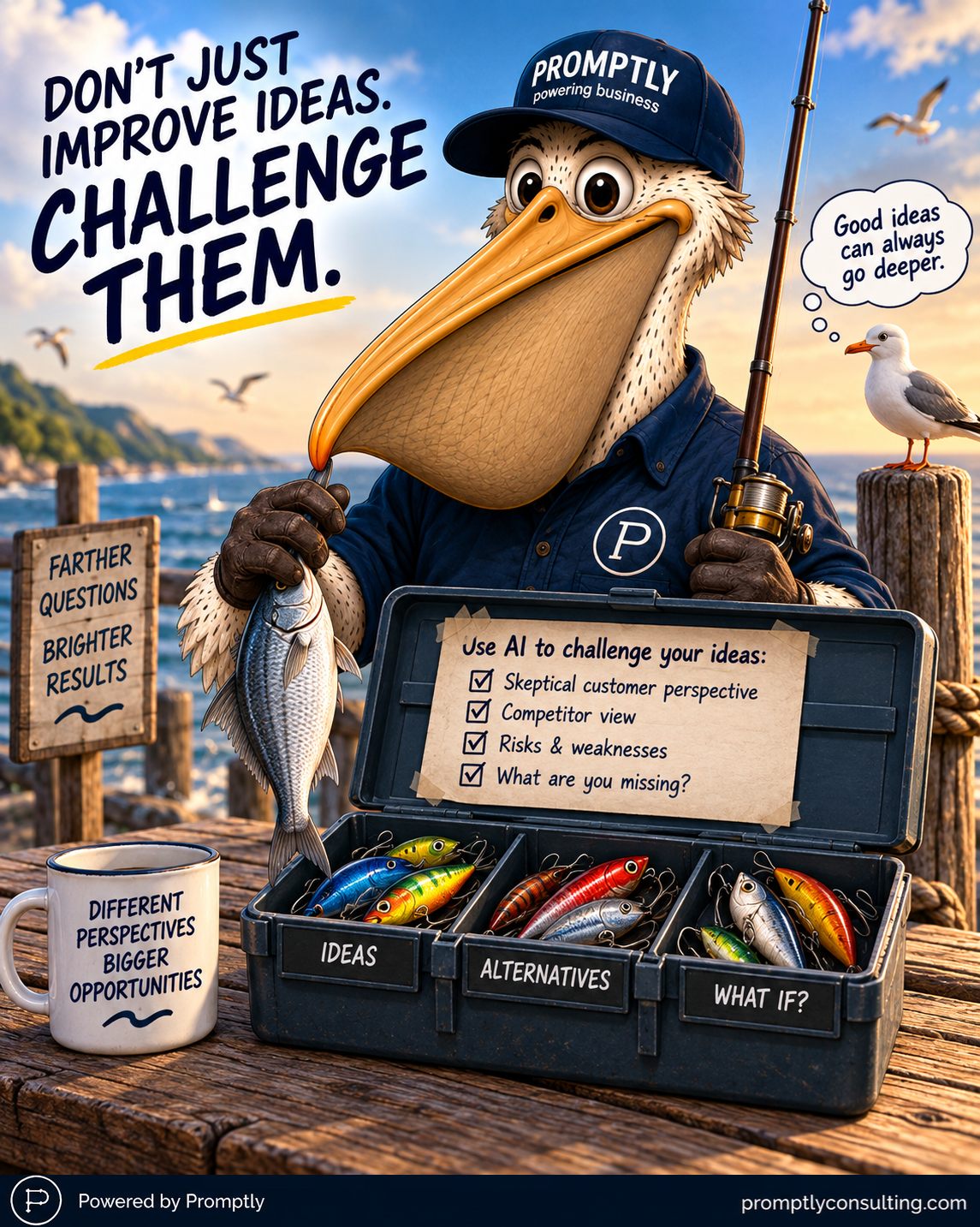
TL;DR: Before you send something important, don't ask AI to improve it. Ask it to attack it. Prompts like "Review this as a skeptical customer. What would make you hesitate?" or "Act as my competitor. What weaknesses would you see in this proposal?" surface the objections you're too close to the work to see. Five minutes of adversarial review before you hit send can save you hours of rework, or a customer.
Most people use ChatGPT, Claude, Copilot, or Gemini as a polishing tool: tighten this, fix the tone, make it sound more professional. That's the smallest version of what these tools can do. The bigger win is using AI as a stress test, a stand-in for the skeptical buyer, the rival vendor, or the executive who reads your proposal looking for holes.
Why should you ask AI to criticize your work instead of improve it?
Because you can't see your own blind spots, and AI can simulate the people who can. When you ask for help, a model tends to accept your framing and make your existing argument sound better. When you ask it to challenge you, it changes perspective, and perspective is the thing you can't manufacture on your own after staring at a document for three hours. You wrote the proposal knowing what you meant. Your customer only knows what's on the page.
What prompts make AI argue with you?
Give the model a role, a stake, and a job. Three that work on almost any document:
- The skeptical customer: "Review this as a skeptical customer. What would make you hesitate, disagree, or lose interest?"
- The competitor: "Act as my competitor. What weaknesses would you see in this proposal?"
- The high-stakes gut check: "I'm about to send this to a $100K customer. What am I missing?"
The pattern is the same each time: name the adversary, name the stakes, and ask for the objection rather than the fix. Then push once more, with "What's the strongest version of that objection?", because the second round is usually sharper than the first.
When is five minutes of adversarial review worth it?
Any time the cost of being wrong is higher than the cost of five minutes. Sales proposals, pricing changes, client-facing emails after a mistake, board updates, job offers, contract terms, product launch copy. If you'd be embarrassed to have a specific person poke a hole in it, have AI play that person first.
Frequently asked questions
What is a red-team prompt?
A red-team prompt asks an AI to take an adversarial role, such as customer, competitor, auditor, or critic, and find weaknesses in your work instead of helping you finish it. The term comes from security testing, where a "red team" attacks a system to expose its flaws.
Won't AI just tell me what I want to hear?
It will if you let it. Models default to agreeableness, which is exactly why the role and the stakes matter: "Act as my competitor" gives the model permission to be hostile. If the feedback still comes back soft, ask directly for the three strongest reasons to say no.
Which AI tools work best for this?
Any capable general-purpose assistant, whether ChatGPT, Claude, Microsoft Copilot, or Gemini, can run adversarial review. The prompt matters far more than the tool.
How is this different from asking AI to proofread?
Proofreading fixes the document you wrote. Adversarial review questions whether you should have written it that way at all: the pricing, the claim, the assumption you never stated.
Key takeaway
Don't only use AI to make your ideas better. Use it to try to break them. The ideas that survive are the ones worth sending.
These are the types of ideas Promptly helps companies embed in everyday processes. Visit promptlyconsulting.com to learn more.