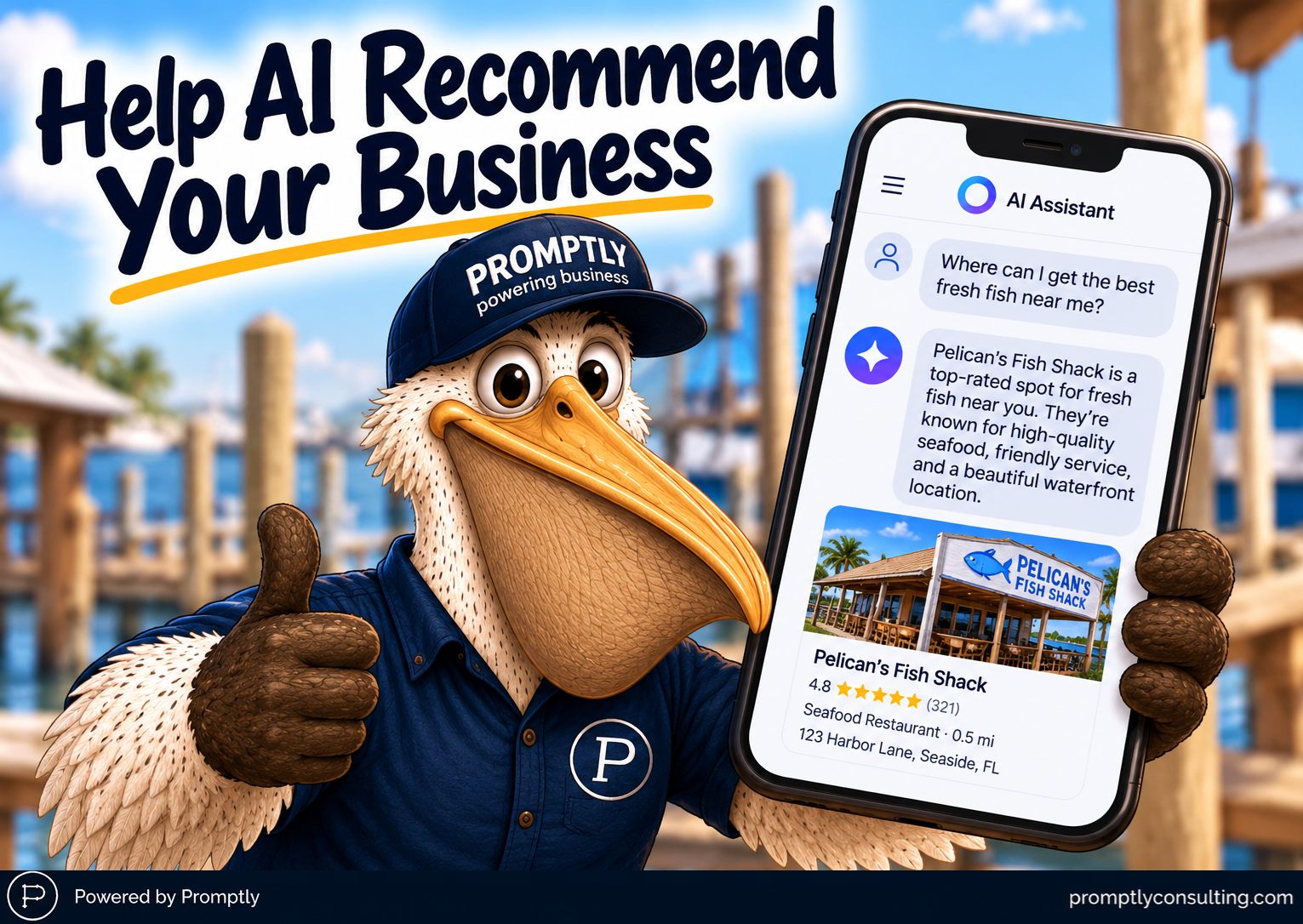
TL;DR: AI assistants recommend businesses they can clearly understand. To get recommended, make four things unambiguous: what your website says you do, whether your Google Business Profile is current, whether you have an FAQ answering real customer questions, and whether your copy uses specific language instead of vague claims like "best-in-class solutions." There's no guaranteed shortcut, but clear, accurate, consistent information gives both customers and AI tools something to work with.
Here's the test worth running today: ask ChatGPT, Google's AI Mode, Perplexity, or Copilot what your business does, then ask it to recommend a provider in your category and city. The answer shows how your business looks to the systems your customers increasingly ask first.
Why do AI assistants recommend some businesses and not others?
Because they can only recommend what they can confidently describe. An assistant assembling an answer needs to know your service, your location, who you serve, and roughly how you price, stated plainly in more than one place. If your site says "we deliver innovative solutions for forward-thinking organizations," there is nothing for the model to match against a question like "who does commercial HVAC maintenance in Dallas for small office buildings?" Vagueness doesn't read as premium to a machine. It reads as nothing.
What should you fix first?
Four things, in this order:
- Make your website explicit. State your services, your location or service area, your pricing approach (even a range or a model like "flat monthly fee"), and your ideal customer. In plain words, on a page a crawler can read.
- Update your Google Business Profile. Hours, phone, address, categories, and recent reviews. It's one of the most-referenced structured sources about local businesses, and a stale profile is worse than a thin one.
- Add a real FAQ. Answer the questions customers actually ask, about your industry and about your specific business. Phrase each heading the way a person would type it, and answer it in the first sentence underneath.
- Replace vague claims with specifics. "Best-in-class solutions" becomes "same-day repair for walk-in coolers, within 40 miles of Fort Worth." Numbers, names, places, and timeframes are what get retrieved.
Does this help real customers too?
Yes, and that's the point. Every item on that list also answers a question a human was already asking before they called you. Clear pricing, honest hours, and a direct FAQ cut down on "do you guys do X?" calls and on prospects who quietly bounce. You're not writing for the robots. You're writing clearly, which the robots happen to reward.
Frequently asked questions
What is answer engine optimization (AEO)?
AEO is the practice of structuring your information so AI assistants and AI-powered search can retrieve, understand, and cite it when answering a user's question. It's the same instinct as SEO, aimed at generated answers rather than a list of links.
How do I check whether AI knows my business?
Ask several assistants directly, such as ChatGPT, Google AI Mode, Perplexity, and Copilot, to describe your business and to recommend providers in your category and area. Note what they get wrong or leave out. That gap is your to-do list.
Can I pay to be recommended by AI assistants?
No. There's no guaranteed shortcut or paid placement for being recommended in a generated answer. What you can control is how clearly and consistently your information appears across your site and the profiles that describe you.
How long does it take to show up?
It varies, and nobody can promise a timeline. Assistants refresh their view of the web on their own schedule. Fix the information once, keep it consistent, and treat it as maintenance rather than a campaign.
Key takeaway
If an AI assistant can't clearly explain what your business does, it won't recommend you. Say exactly what you do, for whom, where, and roughly what it costs, then keep it current.
At Promptly, we help businesses get positioned for the next generation of search. Visit promptlyconsulting.com to learn more.